GbR Verlag
top of page

Novel preview · English edition coming in 2027

What You Leave in Me

By Arno Schikowsky

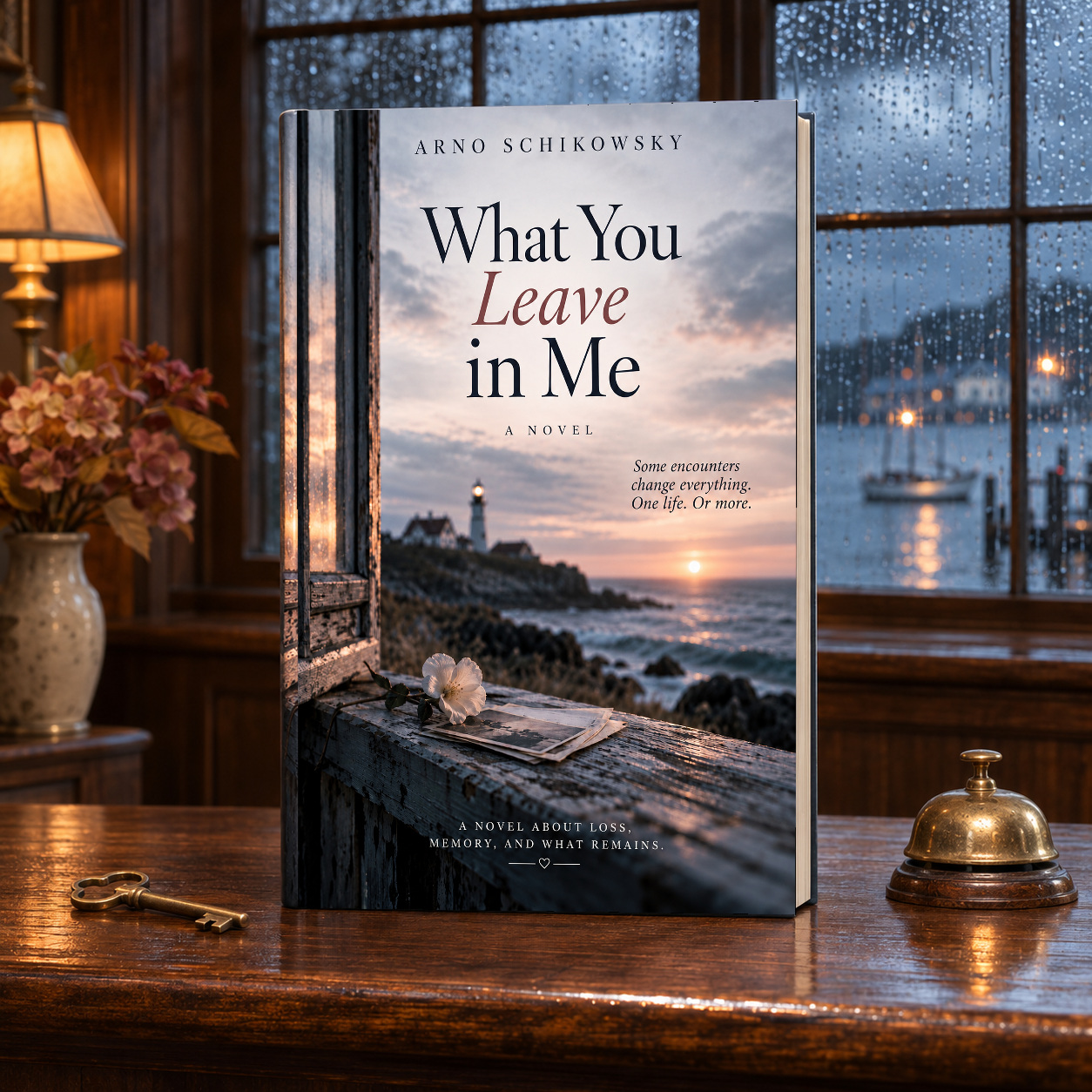
What You Leave in Me on the reception desk at Windward House, beside the brass bell.

The man Mara loves looks thirty-seven. He has looked that way since 1957.

Since her mother’s death, Mara has taken refuge in the night shifts at a small hotel on the coast of Maine. She barely speaks to her sister anymore. She cannot forgive herself for not being there on her mother’s last night.

Then she meets Jonas. With him, she starts to laugh again. Coffee after her shift turns into hours by the sea and, eventually, the wish to wake up beside him.

But an elderly hotel guest recognizes Jonas from his own childhood, sixty-nine years ago. Mara searches for a rational explanation and finds a photograph showing the same young face, the same scar. Jonas would have to be over a hundred years old.

His secret leads her back to the very night her mother died. And it confronts Mara with a decision no one can make for her.

She could send Jonas away before she has even more to lose. Instead, she lets him stay. She wants to love him, even though she understands they can never build a life together.

Mara knows she will lose him. But she refuses to lose the time they could still have together.

What You Leave in Me is a novel about loss and memory, coming in English in 2027. The German edition, Was du in mir zurücklässt, is also scheduled for 2027.

Reading sample · Chapter 1

Room 17

At 12:47 a.m., the front desk phone rang for the fourth time about Room 17.

Mara let it ring twice before she picked up. In the past forty minutes, Mrs. Cole in 17 had asked for an extra blanket, a second pillow, and an opinion on whether the hum in the bathroom was the vent or “something electrical.” Each time, Mara had managed a friendly answer. She found that easier at night. At the front desk, a friendly remark usually went no further than that.

The Windward House had stood above the harbor in Port Ash, Maine, since 1911. In July the porch smelled of sunscreen and the butter they served with lobster. By late October it smelled of wet cedar. The season was over. Nine of the twenty-seven rooms were occupied. Outside, the wind pushed leaves across the steps as if it meant to carry them all the way to the sea.

Mara liked the hotel better this time of year. Fewer voices, fewer expectations. At night she could hear the heating pipes knock, the loose halyard slap against the flagpole, and sometimes the surf beyond the warehouses. Spend enough nights alone with an old building and you got to know it.

“Front desk. Good evening.”

“Now there’s a drip.”

Mara looked up at the ceiling as if that might tell her what was dripping in Room 17. “Where exactly?”

“In the sink.”

“The faucet?”

A pause. “I suppose.”

“I’ll come up.”

She hung up and took the master key. She was about to come around the desk when something struck the glass door from outside.

Mara stopped.

A man was kneeling on the wet pavement outside the entrance. An older man lay beside him, half on his side, his glasses a little way off. The man on his knees raised his head and looked straight at her through the glass.

Mara was at the door before she’d given it a thought.

As she stepped outside, the wind caught the hem of her blouse. The air tasted of salt. From the harbor came the dull, steady clang of a buoy, far enough away that she felt it more than she heard it.

“Don’t let him get up,” she said, crouching down.

“Wasn’t planning to.”

His voice was steady. He kept his eyes on the older man. There was nothing studied about his calm. He seemed to know what to do next.

The older man blinked. Blood ran from a small cut at his temple.

“Can you hear me?” Mara touched his forearm.

“Unfortunately.”

“Well, that’s good.”

“Depends who you ask.”

The stranger smiled briefly. Mara caught it even as she dialed 911.

While she talked to the dispatcher, the stranger sat on the pavement. The rain had soaked his coat dark at the knee. One hand rested on the ground, the other close beside the old man’s arm. Whenever the injured man turned his head, the stranger was where he could see him.

“What’s your name?” Mara asked the injured man.

Before he answered, her eye caught the stranger’s hands. His left lay flat on the wet pavement. With his right he eased the injured man’s glasses out of the way so no one would step on them. His fingers didn’t shake. Mara noticed little things like that without thinking. Four years on nights had taught her to listen less to what people said about themselves and watch what they did when they had no time to decide how it might look.

“Brenner. Arthur Brenner.”

“Mr. Brenner, do you know where you are?”

“Outside a hotel I was hoping to get inside.”

“Very good.”

“I wouldn’t go that far.”

Mara almost laughed. “The ambulance is on its way.”

She looked at the stranger. “And you are?”

“Jonas,” he said. He didn’t give a last name.

“Did you see him fall?”

“Yes. He caught his left foot on the edge. He was out for a few seconds after that. Five, maybe.”

Mara relayed this to the dispatcher. He’d watched the fall closely enough to spare her any follow-up questions. When she hung up, she glanced at the open hotel door. Jonas gave an almost imperceptible shake of his head.

“If he hit his head, I’d leave him where he is.”

Mara didn’t like strangers telling her what to do. She liked it even less when they were right.

“Then let’s at least get something to keep the rain off.”

She fetched two big umbrellas from the luggage room. By the time she got back, Jonas had taken off his coat and laid it over Brenner’s legs.

“You’re going to get wet,” Mara said.

Jonas gave a little shrug. Mara wondered where he’d go afterward. With most people who came through her lobby at night, she knew at least where they’d be going next. With him, she didn’t even know if he had a car waiting somewhere.

“Are you from Port Ash?”

“No.”

“On vacation?”

“Not really.”

“Business?”

“Not really that, either.”

Mara looked at him. “You’re impressively bad at giving simple answers.”

“Maybe your simple questions are hard ones.”

“Where are you from?”

He wiped the rain from one eyebrow. “A lot of places.”

“That’s exactly the kind of answer I mean.”

“I know.”

Arthur Brenner shifted under the coat and winced. Jonas leaned over and quietly asked him where it hurt. As far as he was concerned, his conversation with Mara was over. She stood beside them with the umbrella, watching how easily his whole attention settled on Brenner.

“My bag,” Brenner said.

Mara looked toward the door. A narrow overnight bag stood under the awning, its shoulder strap trailing in a puddle. She drew it closer so Brenner could see it.

“Right here. It’ll go with you.”

“The little pocket on the side.”

She knelt beside him again. With his permission, she opened the pocket and took out a glasses case.

“My other pair’s in there,” he said. “These are only good for distance.”

Jonas held up the wet glasses. The little plastic tip was missing from one arm. Mara put the case with the reading glasses back in the side pocket. Then she took the wet pair from Jonas and tucked them carefully into the main compartment.

“Whenever I go to the hospital, they always want me to read something,” Brenner said.

“Then you’ve got the right pair with you,” said Mara.

Brenner closed his eyes and opened them again at once. “My daughter isn’t here.”

“Would you like someone to call her?”

“In a bit. No point calling her in the middle of the night over every little thing.”

Mara glanced at Jonas. He was still watching Brenner. They both waited for the old man to go on. He told them his daughter’s name and said her number was in his phone. Mara promised she’d tell the paramedics.

She wanted to add that he’d be all right. Instead she lifted the umbrella a little so he could see her face. Brenner kept his eyes open until the first patches of blue light swept across the front of the hotel.

The ambulance arrived seven minutes later. The paramedics asked questions, shone a light in Brenner’s eyes, fitted him with a neck brace. Mara stood by with the umbrella, giving them the names and the hotel address. Jonas stepped back as soon as the professionals took over.

As they slid the stretcher into the ambulance, Mr. Brenner suddenly caught Jonas by the wrist.

Brenner’s face had changed. The dry humor was gone.

“You,” he said.

Jonas didn’t move.

“Mr. Brenner?” the paramedic asked.

The old man kept his eyes on Jonas. Long enough for Mara to hear the rain drumming on the umbrella.

Then Brenner said quietly,

“This time you’re staying.”

Reading sample · Chapter 2

The Man Without a Room

Mrs. Cole didn’t call again.

Later, Mara found that the faucet in Room 17 did, in fact, drip. She gave the handle another turn, laid a towel in the sink, and promised to send the maintenance man up in the morning. Mrs. Cole wasn’t happy with this arrangement, but not quite unhappy enough to call again.

Mrs. Cole lingered in the bathroom doorway. She wore a pale bathrobe with the sleeves pulled down over her hands.

“Did something happen outside?”

“A guest fell. The ambulance took him to the hospital.”

“I saw the flashing lights.”

Mara straightened up. “Well, at least you won’t hear the drip now. We’ll see to the faucet in the morning.”

Mrs. Cole looked into the sink. Two tumblers stood on the shelf, but only one had been used. Beside the mirror lay a printed timetable, folded over and over down the middle.

“I have to leave early tomorrow,” she said.

“Would you like a wake-up call?”

“No. I’ll be awake anyway.”

Mara waited. Mrs. Cole smoothed the sleeve of her robe.

“I’m sorry I called so many times. I’m not usually like this.”

“That’s what I’m here for.”

The answer came automatically. Mara heard how it sounded in the small bathroom and added, “It’s an old building. You can’t always tell which noises belong here.”

Mrs. Cole nodded. She walked Mara to the door and asked if there was someone downstairs all night. Mara said there was. That seemed to do more for her than the towel in the sink.

In the hall, Mara tightened her grip on the master key. She knew that question from guests traveling alone for the first time, and from guests who, even with someone along, still wanted to make sure there was a person awake downstairs. She’d never asked what exactly they were afraid of. Usually it was enough to leave the lobby door unlocked.

When Mara got back to the lobby, Jonas was standing at the window.

The fire had been out for hours. The cushions still smelled of woodsmoke. Beyond Jonas, Harbor Street shone with rain. Farther down, the masts of the fishing boats shifted against one another like thin black strokes.

He had his coat back on. It was dark with rain across the shoulders. She could see his face reflected in the glass. The ambulance was long gone.

“Did you know him?”

Jonas turned. “No.”

“He seemed to know you.”

“So it seems.”

Mara waited.

People usually filled a silence like that. They’d explain too much, or laugh, or ask a question of their own. Jonas did none of those things.

“This is the part where you tell me why a stranger looked at you as if he’d been waiting forty years for you.”

“I’m just not sure it was me he meant.”

“He was holding on to your wrist.”

“That does narrow it down.”

A smile tugged at the corner of his mouth and was gone. Mara noticed a thin scar near his right eyebrow.

She went behind the desk. “Are you staying with us?”

“No.”

“Were you here to see someone?”

“No to that one, too.”

“You have an interesting idea of what to do with a night off, then.”

“I was on my way home.”

She looked past him through the glass. “On foot?”

“Yes.”

By now the rain was coming down so hard that the far side of the street had disappeared behind a gray curtain.

“Of course.”

Jonas looked at the clock above the desk. “You don’t believe me.”

“Nothing personal. As a rule, I don’t believe anybody after midnight.”

“Not even someone with a reservation?”

She didn’t want to laugh. She did anyway.

Four years on nights, and she knew these conversations. Usually people wanted a room, a bathroom, a phone, an outlet. Jonas didn’t need any of those things, and he stayed.

“What about you?” he asked.

“What about me?”

“What brought you here?”

Mara pointed to the desk. “Work.”

“I meant to Port Ash.”

She gave a short laugh. “You ask strangers some pretty personal questions.”

“Then don’t answer.”

Mara said nothing. She half expected him to press her, or at least try to make the question sound more innocent. Jonas just nodded. She didn’t like that she’d noticed that small thing.

He stayed a few more minutes. She offered him a towel. He turned it down at first, then took it when she laid it on the desk without a word.

“How’s Mr. Brenner doing?” Jonas asked.

“I won’t know until tomorrow at the earliest.”

“He’s staying here?”

“Room 24.”

“Alone?”

Mara looked up. “That’s none of your business.”

“You’re right.”

Jonas merely nodded. He smoothed the damp towel once and set it on the desk.

“Thank you.”

“That’s what it’s there for.”

“For men who pick strangers up off the pavement in the middle of the night?”

“Mostly for spilled coffee.”

“Then I’m honored.”

The coffee grinder made more noise than seemed necessary at this hour. Mara set two cups on the counter and poured milk into hers. Jonas took his black.

“You really drink it like that?”

“What’s wrong with it?”

“Nothing. I’d just have thought somebody with that much patience would need sugar.”

“I’m not very patient,” Jonas said.

“You could’ve fooled me out there. I’d have been a different story.”

“You haven’t thrown me out yet,” he said.

Mara laughed. “That’s professional courtesy.”

“Is that different?” Jonas asked.

She leaned against the desk. “Yes. Patience is something you give freely.”

“I can wait,” said Jonas. “I just don’t like it.”

He said it quietly. Mara felt the urge to ask. She didn’t. She didn’t like already wanting to know what a stranger had been waiting for.

He walked to the door.

“Jonas?” Mara said.

He turned.

She had no idea why she’d called him back.

“Your last name.”

He looked at her a moment.

“Weber.”

“Jonas Weber.”

“That’s what it says on most things, anyway.”

“Most things?”

He opened the door. “Good night, Mara.”

He was outside before she could ask how he knew her name.

Then she looked down at the little brass badge on her blouse.

MARA BENNETT.

“Very mysterious,” she muttered to herself.

She sat down at the computer. All she’d meant to do was make sure Mr. Brenner’s registration form was complete. Instead she opened the guest search and typed WEBER.

Three matches. None of them Jonas.

She cleared the name.

At 2:13 a.m., she stepped outside with a cup of coffee. The rain had let up. The empty street glistened under the lamps.

She looked both ways.

Jonas was long gone.

Mara wrapped her arms more tightly around herself. Down at the end of the street she could see a sliver of water between two houses, black and roughened by the wind. She stood there another minute. Twice she looked down the street before she took her coffee back inside.

  • Twitter Social Icon
  • Black Facebook Icon
  • Black Instagram Icon
bottom of page
BücherpostBook mail

Post vom Verlag

Wöchentlicher BücherbriefJeden Mittwoch eine Szene oder ein Gedanke aus einem unserer Bücher.NeuerscheinungenEine Nachricht, wenn ein neues Buch im Verlag erscheint.

From the publisher

Weekly book letterA scene or an idea from one of our books, every Wednesday.New releasesHear from us when we publish a new book.